Forget the manufacturer claims. We put these two mid-drives on our test rig to find out which one actually delivers.
What’s the Deal with Mid-Drive Motors and Why Does It Matter?
Before we dive into the hard numbers, here is a quick primer for anyone new to e-bike builds.
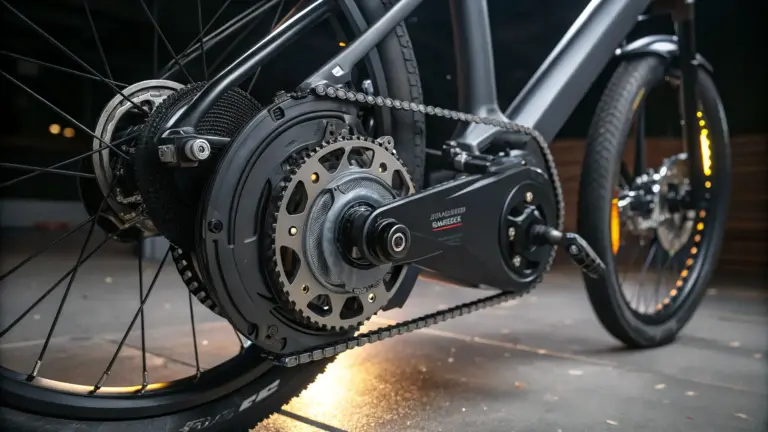
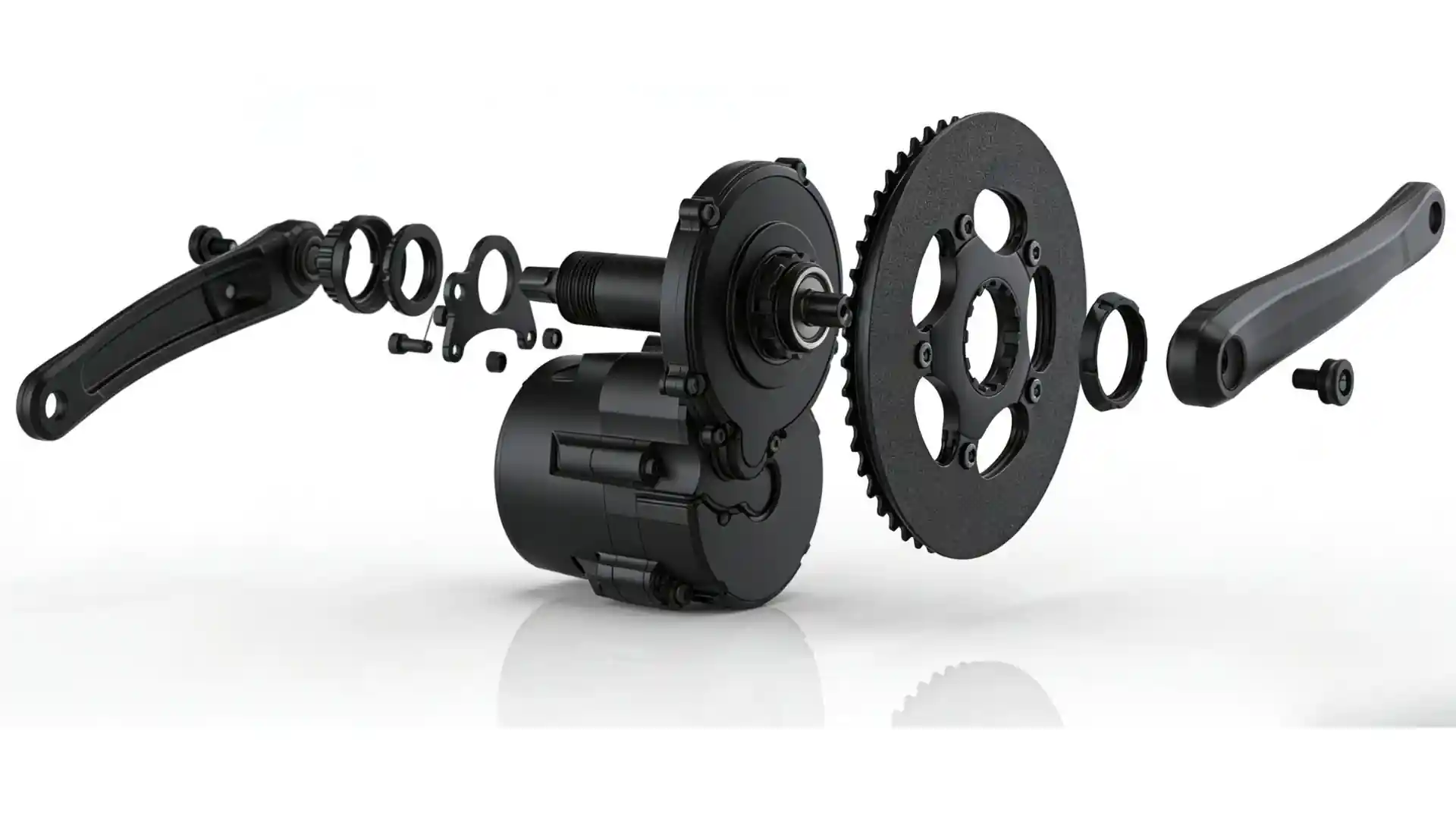
There are two main types of electric bike motors: hub motors (which sit inside the wheel hub and push the wheel directly) and mid-drive motors (which are mounted at your bike’s crankset, right where the pedals attach).
The genius of a mid-drive motor is its location. Instead of pushing the wheel directly, it delivers power through your bike’s existing chain and rear cassette. This means when you shift into a low gear to climb a steep trail, the motor benefits from that exact same mechanical advantage, multiplying its effective torque at the rear wheel. A mid-drive pushing 80 N.m through your gears can deliver over 160 N.m at the rear wheel—easily two to three times the real-world pushing power of a standard hub motor. This is why mid-drives dominate the performance e-bike, e-MTB, and e-cargo spaces.
In this breakdown, we are looking at two premium, high-power mid-drives rated up to 1,000 W: the Tongsheng TSDZ16 and the Toseven DM01.
Before we compare the stats, we need to address the elephant in the room: You will not find this data anywhere else on the web. We are incredibly proud to be the first and only independent publication to put these two motors on our own testing rig and publish the raw characteristic curve data. Usually, DIY builders have to rely on marketing fluff or sponsored YouTube opinions. Not today. We strapped these motors to our dyno in March 2026, and we are breaking down the exact engineering numbers so you can see the truth for yourself.
A quick note on how to read this data: The numbers below come from our independent laboratory motor characteristic curve tests. This is a rigorous test where the motor is loaded from zero to maximum torque while sensors continuously record everything. As with all lab data, your real-world mileage may vary slightly based on your specific battery, your controller settings, and how you mount it. Treat these numbers as a highly accurate engineering baseline.
Who Are the Manufacturers Behind the Motors?
Tongsheng (Est. 1998)
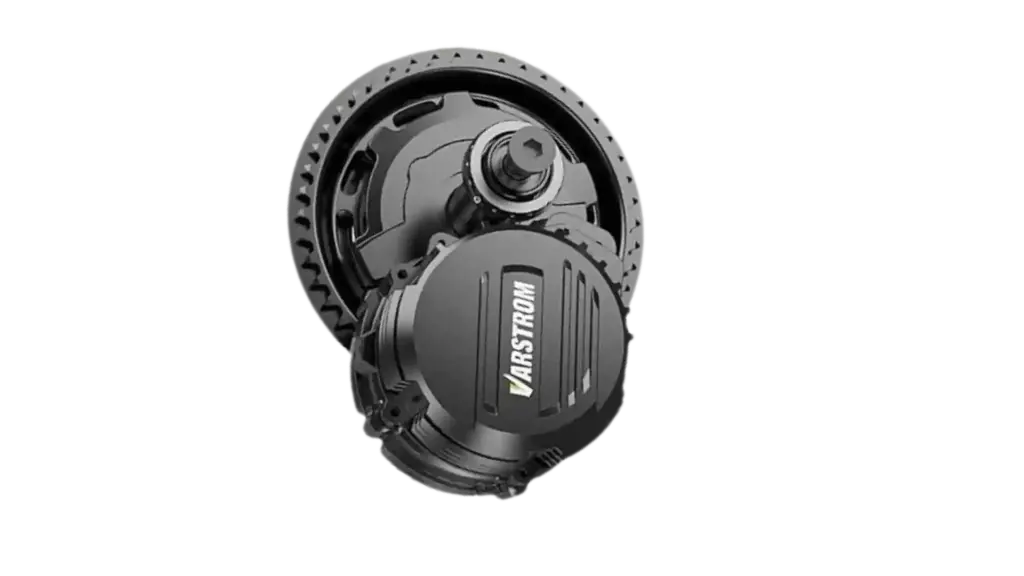
Suzhou Tongsheng Electric Co., Ltd. has been building e-bike motors since 1998. If you’ve looked into DIY e-bike kits, you’ve probably come across their TSDZ series. They are a highly established manufacturer with ISO 9001 and TUV certifications, and they’ve built a strong reputation over the years for providing smooth, torque-sensing assist. The TSDZ16 is their newest generation, building directly on decades of proven, reliable design.
Official website: tongsheng-e.com
Toseven Motors (Est. 2021)
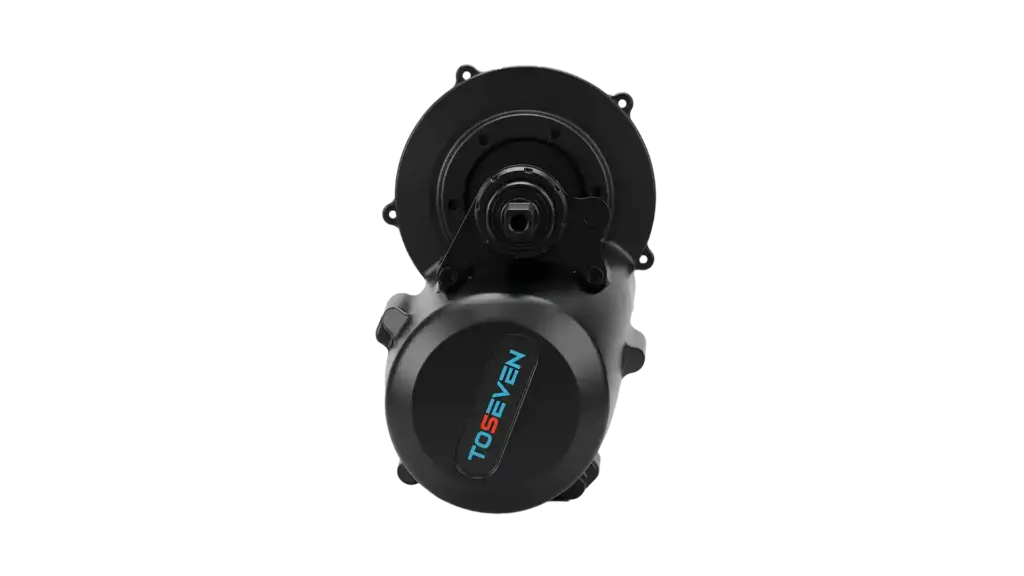
Toseven Motor was founded in 2021 and has quickly become a notable competitor in the mid-drive space. Also carrying ISO and TUV certifications, their DM-Series (which includes the DM01) was designed to tackle some of the common mechanical quirks of older mid-drives. They opted to replace the traditional one-way needle roller bearing with a spline-connection and an all-in-one modular build to make garage maintenance much more straightforward. With native support for 48 V, 52 V, and 60 V batteries and an IP65 waterproof rating, Toseven delivers a very capable, modern motor architecture.
Official website: to7motor.com
Are the Test Conditions Actually Fair?
Before comparing the stats, we had to make sure both motors were fed the exact same diet in our lab.
| Parameter | Toseven DM01 | Tongsheng TSDZ16 |
| Test Date | 20 March 2026 | 18 March 2026 |
| Supply Voltage (V) | 49.0 V | 48.3 V |
| Turning Direction | Forward | Forward |
| Total Test Points | 67 data points | 66 data points |
| Rated Power | 1,000 W | 1,000 W |
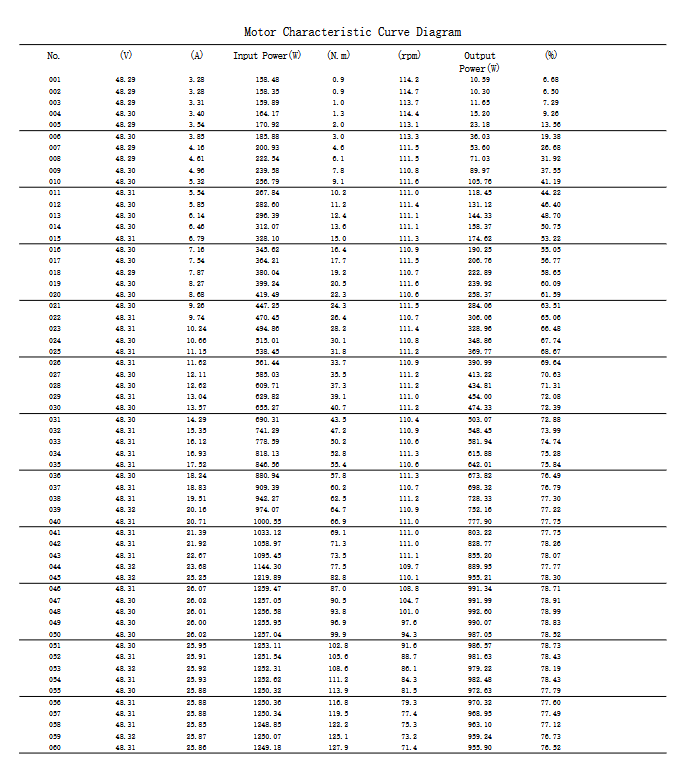
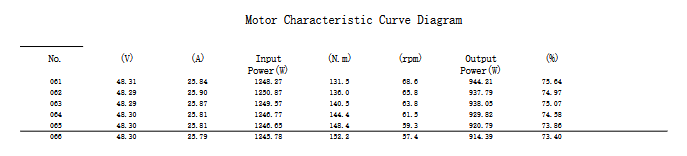
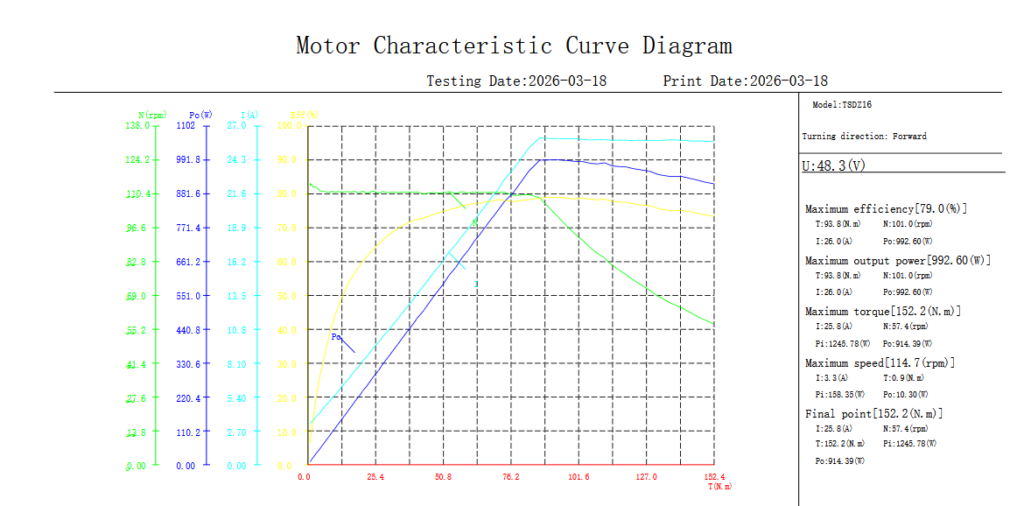
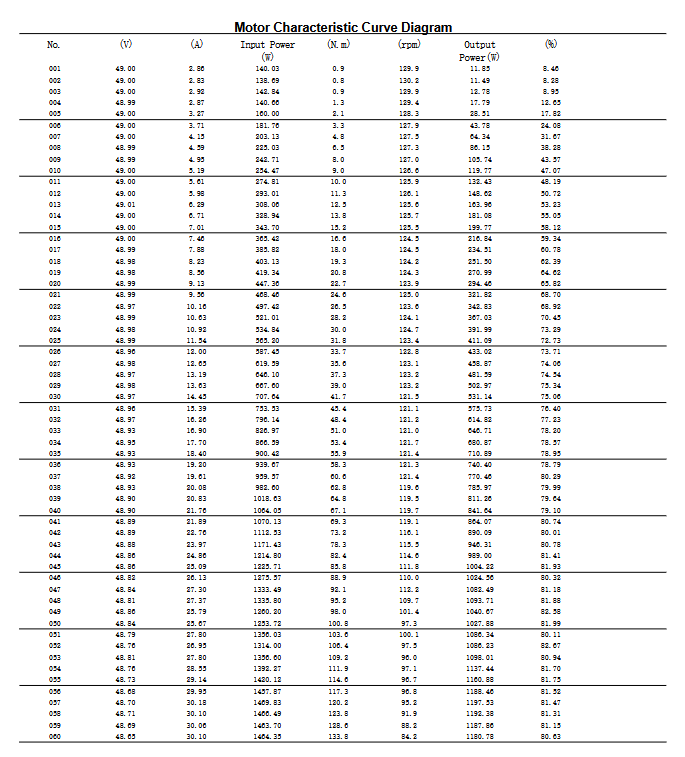
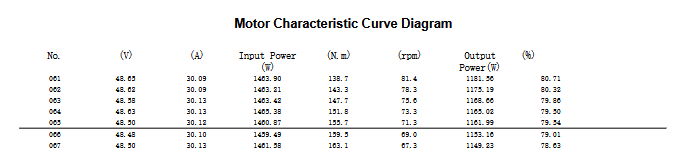
With near-identical supply voltages (49.0 V vs 48.3 V) during our testing, this is a completely fair, apples-to-apples baseline. Any differences in performance come down to how the motors are built, not how much juice they were handed. Below shows a snippet of our studies, the rest of the data can be seen at the end of the article.
Tongsheng TSDZ16 Motor Characteristic Curve Diagram:
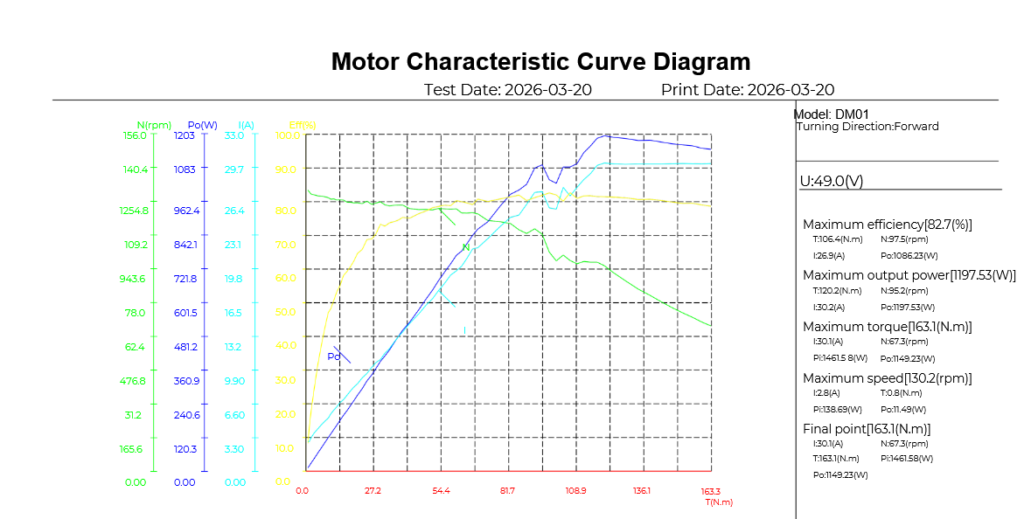
Toseven Motor DM01 Motor Characteristic Curve Diagram:
The Raw Numbers: Which Motor Climbs Easier and Smoother?
Power is what conquers hills. Measured in watts, it is the rate at which a motor converts battery energy into forward momentum.
Peak Output Power
- The DM01 achieves a maximum output power of 1,197.53 W at a torque of 120.2 N.m and 95.2 rpm, drawing 30.2 A from the supply.
- The TSDZ16 tops out at 992.60 W at 93.8 N.m and 101.0 rpm, drawing 26.0 A.
What does this actually mean for your ride? The DM01 has a 204.93 W advantage (about 20.7% more power). If you and a buddy are climbing the same steep fire road, and your bike is pushing almost 1,200 watts while his is tapping out under 1,000, you are going to cruise past him. If you’re hauling a cargo bike full of groceries up a steep driveway, the DM01 won’t make you sweat. The TSDZ16, tapping out at under 1000 watts, is going to make you work a bit harder for it.
Input Power (Battery Drain)
At maximum torque, the DM01 draws up to 1,461.58 W from the battery, while the TSDZ16 peaks at 1,245.78 W.
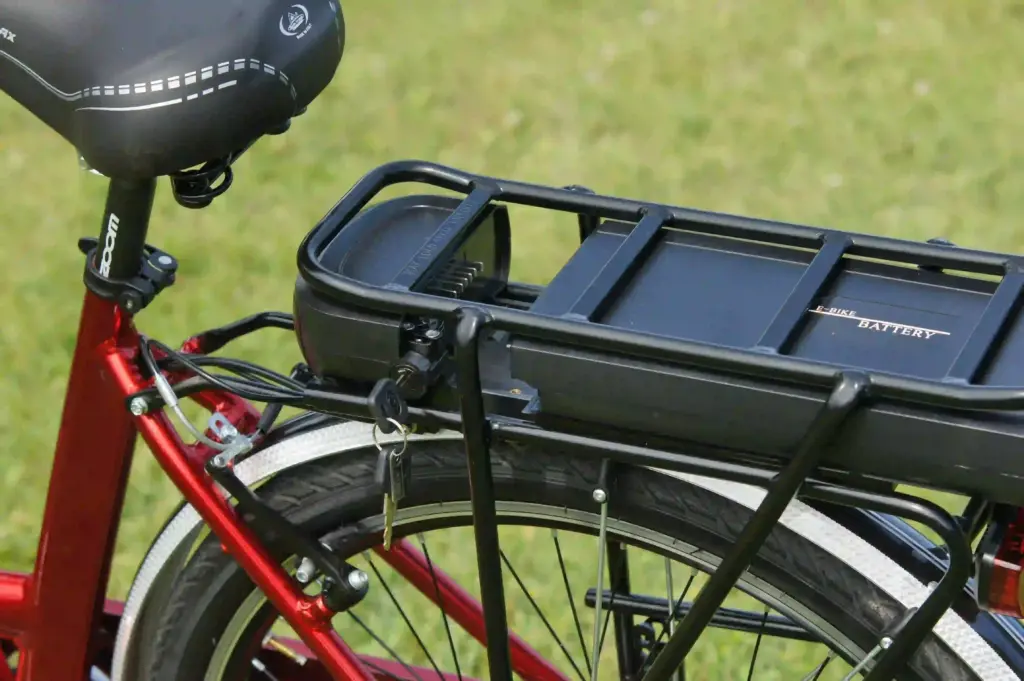
What does this actually mean for your ride? The DM01 is thirstier. It demands a lot more from your battery. If you are running a cheap, older, or low-discharge battery pack, the DM01’s high current draw could cause significant voltage sag. You need a robust battery to feed the DM01, whereas the TSDZ16 is a bit gentler on standard packs.
The Pulling Force: Which Motor Offers Better Take-Off Power?
Torque (measured in N.m) is the raw twisting force the motor puts on your chain.
Peak Torque
- The DM01 delivers a maximum torque of 163.1 N.m at 67.3 rpm.
- The TSDZ16 reaches 152.2 N.m at 57.4 rpm.
What does this actually mean for your ride? The DM01 gives you a 10.9 N.m (+7.2%) advantage. Because your bike’s gearing multiplies this force (often by a ratio of 40:1), that 10.9 N.m difference translates to a massively more forceful push at the rear tire when you are trying to get moving from a dead stop on a hill. Also, notice that the TSDZ16 hits its peak torque at a lower RPM (57.4 vs 67.3). This means the Tongsheng will physically stall out earlier than the Toseven when the hill gets impossibly steep.
Battery Drain: Which Motor Gives You More Range?
Efficiency is simply the percentage of battery power that actually turns your wheel versus the percentage that is wasted as heat.
Peak Efficiency
- The DM01 achieves a peak efficiency of 82.7% at 106.4 N.m (97.5 rpm).
- The TSDZ16 peaks at 79.0% at 93.8 N.m (101.0 rpm).
What does this actually mean for your ride? A 3.7% difference sounds tiny on paper, but it adds up. Over a 100 km ride drawing an average of 500 W, the DM01 will save you roughly 18-20 Wh of battery. That is real, tangible range that translates to several extra miles before your battery dies.
Efficiency Across the Load Range
| Load Range | DM01 Efficiency | TSDZ16 Efficiency |
| Light load (under 20 N.m) | 8-55% | 7-53% |
| Mid load (40-80 N.m) | 75-80% | 72-77% |
| Peak efficiency zone (90- 120 N.m) | 80-82.7% | 78-79% |
| Heavy load (over 140 N.m) | 78-79% | 74-75% |
| At max torque (stall point) | 78.63% | 73.40% |
What does this actually mean for your ride? Look at the bottom row. The DM01 sits at 78.63% efficiency right at its stall point, while the TSDZ16 drops to 73.40%. When you are fighting up the steepest section of a trail and the motor is under maximum stress, the DM01 wastes significantly less energy. The TSDZ16 will heat up faster and burn through your battery quicker in extreme conditions.
Top Speed and Gearing: Which Motor Spins Faster?
The free-spin (no-load) speed dictates how the motor behaves at the top of its RPM range.
No-Load Maximum Speed
- The DM01 spins to 130.2 rpm at no load (drawing 2.8 A, producing 11.49 W of output).
- The TSDZ16 tops out at 114.7 rpm (drawing 3.3 A, producing 10.30 W).
What does this actually mean for your ride? The DM01 spins 15.5 rpm faster (a 13.5% advantage). If you want to build a bike with a high top speed, the DM01 gives you much more flexibility with your gear ratios before the motor tops out and stops assisting you.
Note: The TSDZ16 does operate at a slightly higher RPM at its absolute peak efficiency (101.0 rpm vs the DM01’s 97.5 rpm), meaning it likes to be spun a little faster when cruising in its sweet spot.
The Final Scorecard
| Metric | Toseven DM01 | Tongsheng TSDZ16 | Highlight |
| Max Output Power | 1,197.53 W | 992.60 W | DM01 (+20.7%) |
| Max Torque | 163.1 N.m | 152.2 N.m | DM01 (+7.2%) |
| Peak Efficiency | 82.7% | 79.0% | DM01 (+3.7 pp) |
| Max Speed (no-load) | 130.2 rpm | 114.7 rpm | DM01 (+13.5%) |
| Efficiency at Max Torque | 78.63% | 73.40% | DM01 (+5.2 pp) |
| Supply Voltage | 49.0 V | 48.3 V | ≈ Equal |
| Max Current Draw | 30.2 A | 26.0 A | TSDZ16 (lower draw) |
| Max Input Power | 1,461.58 W | 1,245.78 W | TSDZ16 (lighter load) |
| Waterproof Rating | IP65 | IPX6 | ≈ Equal |
| Operating Temperature | -20°C to 50°C | N/A in test data | DM01 (documented) |
Honest Pros and Cons from a Builder’s Perspective
Toseven DM01
Where it Shines: Raw Power: At nearly 1,200 W and 163.1 N.m of torque, it is an absolute beast for heavy cargo bikes or steep MTB trails.
- Battery Economy: Peaking at 82.7% efficiency means less heat and more miles.
- Modern Mechanics: Ditching the old one-way needle roller bearing and using a spline connection makes garage installation and maintenance much less of a headache.
- Voltage Flexibility: Natively supports 48 V, 52 V, and 60 V systems.
Where it Hurts: Battery Stress: Pulling 30.2 A at peak requires a high-quality battery with a strong BMS. Budget packs might suffer under this load.
- Unproven Longevity: They’ve only been around since 2021. We don’t have 15 years of forum data to know how these hold up over a decade of abuse.
- Proprietary Ecosystem: You are largely locked into Toseven’s specific displays and accessories.
Tongsheng TSDZ16
Where it Shines: Battery Friendly: Capping out at 26.0 A makes this motor incredibly safe for standard or older lithium packs.
- Established History: Tongsheng has been building these since 1998. They are a proven brand that has been around a long time.
- Huge Aftermarket & Community: Because it’s an established platform, you can find parts, third-party controllers, and displays anywhere on the internet. You will also find countless rebuild tutorials, troubleshooting guides, and forum threads out there if you ever need help.
Where it Hurts: Lacks Punch: Falling short of 1,000 W makes it feel sluggish compared to modern heavyweights when you really need power.
- Heat Waste: Dropping to 73.40% efficiency under heavy load means it turns too much of your battery into heat on steep climbs.
- Gearing Limits: The 114.7 rpm speed ceiling restricts how fast you can gear the bike.
Technical Limitations: Where Do These Motors Still Need Work?
Based on our lab results, if we had the ear of the engineers at the factory, here is what we would tell them to fix:
For the Toseven DM01:
- Thermal Testing: Because it pulls up to 30 amps, we want to see structural thermal soak tests. Can the casing and bearings handle 30 amps continuously for 30 minutes without melting the windings?
- Low-Speed Efficiency: Below 20 N.m of load, both of these motors suck (8-55% efficiency). Since most urban riders spend a lot of time coasting lightly, Toseven needs to tweak their firmware to stop wasting battery at low speeds.
- Standby Drain: At a dead free-spin (no-load), the DM01 draws 138.69 W from the battery but only produces 11.49 W of actual output. That is a lot of parasitic loss from internal friction and magnetic drag that needs to be cleaned up.
For the Tongsheng TSDZ16:
- Rewind the Stator: Capping out at 79% efficiency is old news. They need to use thicker copper or a better winding pattern to cross the 81% threshold and stop wasting heat.
- Unlock the RPM: 114.7 rpm is too slow for modern builds. They need to reduce internal friction to let this motor spin past 120 rpm.
- Release a “Pro” Version: The architecture is clearly conservative. If they built a reinforced version that could handle 30 amps, they could close the 200 W power gap with the DM01 almost instantly.
The Final Verdict: Which One Should You Actually Buy?
Both of these mid-drive motors are excellent, highly reliable pieces of engineering that will serve almost any DIY builder well. However, through analyzing our own exclusive lab data—which we are immensely proud to publish for the very first time—our Editor’s Choice award definitively goes to the Toseven DM01.
The Tongsheng TSDZ16 is a fantastic, battery-friendly workhorse with a massive aftermarket ecosystem. If you are building a standard daily commuter and want a proven platform, it remains a highly respectable option.
But the DM01 simply outclasses it in raw performance and modern design. It is objectively more powerful, spins faster, and is significantly more efficient under heavy stress. If you want the absolute best engineering and a motor that won’t break a sweat on steep climbs or heavy cargo hauls, the DM01 takes the crown. Just make sure you pair it with a premium battery pack that can handle its 30-amp draw, and enjoy the ride.
Toseven DM01 – Raw Test Data (Click to Expand)
Tongsheng TSDZ16 – Raw Test Data (Click to Expand)